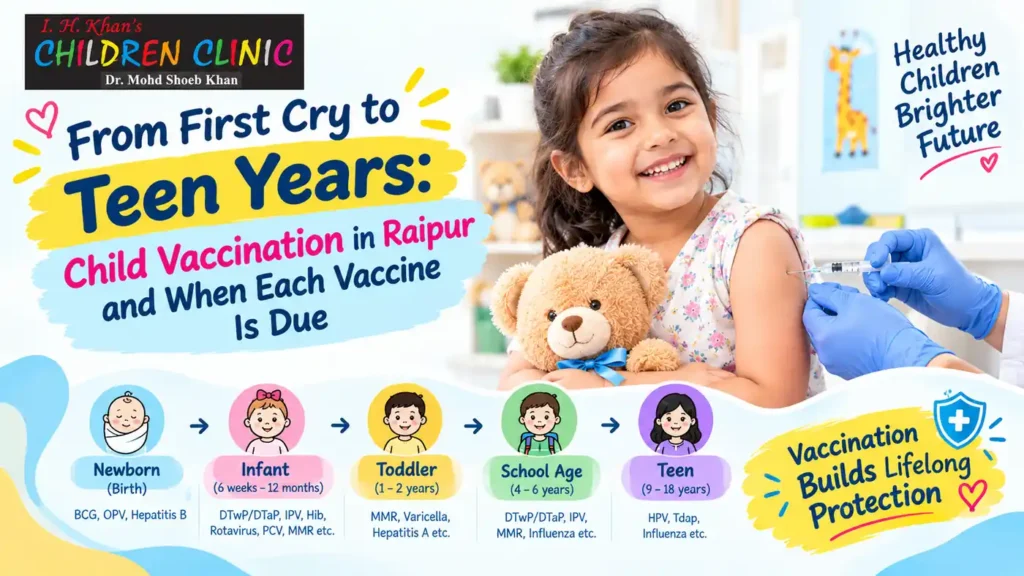
Parents often ask the same question at every clinic visit: which vaccines does my child need now, and what comes next? Vaccination does not end with the injections a baby receives in the first few months. Protection continues through the toddler years, school age and adolescence, with different vaccines and boosters due at different stages.
If you are planning child vaccination in Raipur, knowing the broad timeline helps you prepare for each visit and spot a missed dose early. This guide covers the vaccines commonly recommended from birth to 18 years, based on the Indian Academy of Pediatrics (IAP) immunization schedule, and explains what to do when a dose is delayed. At I.H. Khan’s Children Clinic, Dr. Mohd Shoeb Khan, an experienced pediatrician, reviews each child’s vaccination card and advises on the doses due next.
Quick answer: Children receive vaccines at birth, at 6, 10 and 14 weeks, at 6, 7, 9 and 12 months, at 15 and 16 to 18 months, at 4 to 6 years and again between 9 and 18 years. The exact list depends on your child’s age, earlier doses and your pediatrician’s advice.
Why do children need different vaccines at different ages?
A child’s immune system matures in stages, and so does the risk of infection. Newborns need early protection against infections such as tuberculosis and hepatitis B. Babies need several doses of the same vaccine to build lasting immunity. Older children need boosters because protection from early doses can fade with time. Teenagers need vaccines against infections they may meet later in life, such as those linked to HPV.
This is why one vaccination card carries entries from birth to adolescence. Carry it to every Children Clinic Raipur visit, because each entry marks a dose that builds on the one before it.
Which vaccines does a newborn need at birth?
Newborns usually receive three vaccines in the first days of life:
- BCG: helps protect young children from severe forms of tuberculosis.
- Oral polio vaccine (OPV): the birth dose starts protection against polio.
- Hepatitis B, dose 1: given within 24 hours of birth to protect the liver from the hepatitis B virus.
Ask the hospital for the vaccination card before discharge, because every later visit for child vaccination in Raipur builds on these first entries. If your baby was born outside a hospital or missed a birth dose, tell your pediatrician at the first visit. Timing matters for some birth doses, so a pediatrician can advise what is still possible.
What vaccines does a baby need in the first 6 months?
Primary doses begin at 6 weeks and repeat at 10 and 14 weeks. Most families planning child vaccination in Raipur start these visits at a clinic they can reach easily, since three visits fall within two months. Each visit usually includes several vaccines, often combined into fewer injections.
- At 6 weeks: first doses of DTwP or DTaP, IPV, Hib, rotavirus and PCV, along with the second dose of hepatitis B.
- At 10 weeks: second doses of DTwP or DTaP, IPV, Hib, rotavirus and PCV. Hepatitis B doses continue as part of combination vaccines according to your pediatrician’s plan.
- At 14 weeks: third doses of DTwP or DTaP, IPV, Hib and PCV. Rotavirus continues where the vaccine brand needs a third dose.
- At 6 months: first dose of the influenza vaccine. A second dose follows after a gap, usually at 7 months.
Here is what each of these vaccines protects against:
- DTwP and DTaP: diphtheria, tetanus and pertussis (whooping cough).
- IPV: polio, given as an injection.
- Hib: serious infections such as meningitis and pneumonia caused by Haemophilus influenzae type b.
- PCV: serious pneumococcal infections, including pneumonia and meningitis.
- Rotavirus vaccine: severe diarrhea in infants.
Which vaccines are due between 6 months and 2 years?
This stage brings the most follow-up visits in child vaccination in Raipur, because several vaccines need a second dose or a booster.
- 6 to 9 months: typhoid conjugate vaccine, as a single dose.
- 7 months: second dose of the influenza vaccine for a child receiving it for the first time.
- 9 months: MMR dose 1, which protects against measles, mumps and rubella.
- 12 months: hepatitis A. One dose is enough with a live attenuated vaccine. An inactivated vaccine needs two doses, six months apart.
- 15 months: MMR dose 2, varicella (chickenpox) dose 1 and a PCV booster.
- 16 to 18 months: boosters of DTwP or DTaP, Hib and IPV.
- 18 to 19 months: second hepatitis A dose (inactivated vaccine only) and second varicella dose, given three to six months after the first.
Parents sometimes wonder why a one-year-old needs so many visits. Spacing the doses gives the immune system time to respond to each one, and boosters keep that response strong. Regular visits to a Children Clinic Raipur families trust make it easier to keep these dates on track.
What vaccines do children need between 2 and 6 years?
Fewer injections fall in these years, but they still matter. Two items stay on the list:
- Every year until 5 years: influenza vaccine, usually given before the monsoon season.
- At 4 to 6 years: boosters of DTwP or DTaP and IPV, along with MMR dose 3.
Children who completed three doses of fractional IPV under the national programme still need an IPV booster at 4 to 6 years. Bring the full card to a Pediatrician in Raipur before school admission so the next dose is not missed. The pre-school visit is a practical time to review the schedule for the years ahead.
Which vaccines do pre-teens and teenagers need?
Adolescent vaccination often gets forgotten because the clinic visits become less frequent, so ask a Pediatrician in Raipur about these doses at the 9 to 10 year check. The IAP schedule recommends:
- 9 to 14 years: HPV vaccine, two doses given six months apart, for girls and boys.
- 10 to 12 years: one dose of Tdap. This is not needed if Tdap was already given at 9 years or later.
- 15 to 18 years: HPV vaccine in three doses (at 0, 2 and 6 months) for those who did not start earlier.
- 16 to 18 years: one dose of Td.
HPV stands for human papillomavirus, an infection linked to cervical and several other cancers later in life. Starting before 15 years needs two doses, while a later start needs three.
Is the IAP schedule the same as the government immunization schedule?
The IAP schedule and the government’s Universal Immunization Programme overlap but are not identical. The government programme provides selected vaccines free of cost at government health facilities. The IAP schedule recommends some vaccines beyond those offered in the national programme at a given time, and it may use different combination vaccines or brands. The national programme is also updated from time to time.
Both aim to protect children. Whichever route you choose for child vaccination in Raipur, keep a single card that records every dose. Your pediatrician can explain which doses your child has already received and which are still due.
What should you do if your child misses a vaccine?
A missed dose does not usually mean starting the series again. A Pediatrician in Raipur checks the dates on your child’s card, picks up from the last dose received and sets a catch-up plan. Some vaccines have an upper age limit for starting a series, so booking a visit soon after a missed date is easier than waiting.
If your child has missed a vaccine, bring the vaccination card to I.H. Khan’s Children Clinic for individual guidance on child vaccination in Raipur.
What can parents expect after a vaccine visit?
Many children show mild and temporary reactions such as soreness or redness at the injection site, a low fever, tiredness or irritability. Reactions vary with the vaccine. Keep your child comfortable and follow the pediatrician’s aftercare advice. Avoid giving medicines routinely before or after vaccination unless a doctor advises it.
Contact your Pediatrician in Raipur if symptoms worry you, last longer than expected or get worse. Seek emergency care at once if your child has difficulty breathing, swelling of the face or throat, collapse or unusual drowsiness that makes the child hard to wake.
How can parents keep track of their child’s vaccines?
Simple habits make it easier to keep every dose recorded and on time.
- Keep one card: store the vaccination card in a fixed place and carry it to every visit, including visits for fever or cough.
- Take photos: click a clear picture of every page so a copy stays on your phone.
- Set reminders: note the next due date on your phone calendar before leaving the clinic.
- Record reactions: write down any reaction after a dose so the pediatrician can plan the next one.
- Share the card at school entry: schools and some travel plans may ask for immunization records.
- Use one clinic where possible: continuing at the same Children Clinic Raipur parents already know keeps the record in one place.
Why consult a pediatrician for child vaccination in Raipur?
Every child has an individual health history and vaccination record. A pediatrician reviews earlier doses, explains the schedule, answers parental concerns and advises on catch-up vaccination where needed.
Dr. Mohd Shoeb Khan holds an MBBS and an MD in Pediatrics, with a Fellowship in Neonatology and over 11 years of experience. He provides pediatric consultations at I.H. Khan’s Children Clinic in Raipur, where parents can discuss newborn care, childhood immunization, missed doses and previous vaccine reactions. For families searching for a Pediatrician in Raipur, a vaccination visit is also a good time to talk about growth, nutrition and development.
Frequently Asked Questions
At what age does a child start vaccination?
Child vaccination in Raipur starts at birth with BCG, OPV and the first dose of hepatitis B. The next set of vaccines is due at 6 weeks.
How many vaccines does a child need in the first year?
Children receive vaccines at birth, at 6, 10 and 14 weeks, at 6 and 7 months, at 9 months and around 12 months. Many are combined into a single injection, so the number of injections depends on the vaccine brands your pediatrician uses.
Do children need vaccines after 5 years of age?
Yes. Child vaccination in Raipur does not stop at school entry. Boosters are due at 4 to 6 years and again at 10 to 12 and 16 to 18 years. HPV vaccine is recommended between 9 and 14 years, and yearly influenza vaccination continues for some children, especially those with a higher risk.
Can a child get vaccinated with a cold or mild fever?
A mild cold often does not need a delay, but a moderate or severe illness may. Tell the pediatrician how your child is feeling, and the doctor will decide whether to go ahead or reschedule.
Can several vaccines be given at the same visit?
Yes. Many vaccines are safely given together, and pediatricians follow recommended combinations and gaps between doses.
Is it too late to vaccinate an older child who missed doses?
Catch-up vaccination is possible for many vaccines. A Pediatrician in Raipur reviews the child’s age and records, then plans which doses to give and when.
Choose I.H. Khan’s Children Clinic for Child Vaccination in Raipur
Keeping immunization records updated and following the recommended schedule helps parents stay prepared for every stage of childhood. I.H. Khan’s Children Clinic is located in Avanti Vihar, Shankar Nagar, Raipur, and provides pediatric consultations for newborns, infants and growing children. Parents looking for a Children Clinic Raipur can contact the clinic to ask about vaccination guidance and appointment availability.
Clinic Name: I.H. Khan’s Children Clinic
Doctor: Dr. Mohd Shoeb Khan
Phone: +91 9584007868
Address: C11, Avanti Vihar Road, near Hanuman Mandir ATM, Sector 1, Shankar Nagar, Raipur, Chhattisgarh 492001
Clinic Hours: Monday to Sunday, 10:00 AM to 1:00 PM and 5:00 PM to 9:00 PM
Book a consultation today to review your child’s vaccination card, plan the next dose or discuss missed vaccines.

At I.H. Khan's Children Clinic, we are dedicated to providing exceptional pediatric care for children of all ages. Led by Dr. Mohd Shoeb Khan, a highly experienced Pediatrician and Neonatologist, our clinic focuses on offering personalized healthcare services to ensure the well-being of every child. We provide a wide range of services, including newborn care, growth and development assessments, vaccinations, and management of pediatric infections. Equipped with modern medical facilities and advanced technologies, we ensure that each child receives the best possible care in a compassionate and comfortable environment. At I.H. Khan's Children Clinic, we prioritize the health, safety, and happiness of your child, making their care our top priority.